The Story of Bai’s Handmade Pipa
SILK ROAD LUTE delivers premium hand‑crafted Chinese Pipa instruments.
Our master luthier is a direct disciple of Gao Zhanchun, a distinguished inheritor of China’s intangible cultural heritage pipa‑making craft.
Combining time‑honored master‑passed techniques with decades of personal practical experience, our luthier develops a unique tonal philosophy for every pipa.
Each instrument produces rich, soul‑stirring and immersive sound, deeply touching the listener’s heart.
Every pipa is entirely hand‑built following traditional craftsmanship. No mass‑production, no machine‑made bodies.
Custom orders require a 3‑4‑month lead‑time for careful wood seasoning, hand‑carving and precise tonal fine‑tuning.
We select premium solid wood to pursue authentic, warm traditional pipa tone.
Browse our shop collection. All inquiries about customization, material options and pricing are handled through SILK ROAD LUTE.
Please reach out via our website contact form.
Craftsmanship of Bai’s Pipa
Chapter 1 Origin of Bai’s Pipa Craftsmanship
1.1 Historical Background
Rooted in China’s time-honored traditional pipa craftsmanship, Bai’s pipa making art was inherited from Master Gao Zhanchun, an officially recognized inheritor of China’s Intangible Cultural Heritage for Pipa Production. After over three decades of rigorous study and practice, the craft has evolved into a distinctive and independent production system.
As one of China’s four classic ancient stringed instruments, the pipa carries profound historical and cultural heritage. Its manufacturing techniques have matured over more than a thousand years since the Tang Dynasty and formed an intricate traditional craft system. Building upon quintessential ancestral workmanship, Bai’s Pipa seamlessly integrates modern acoustic science and standardized production management to establish a systematic production framework, revitalizing this ancient craft for contemporary times.
1.2 Lineage & Inheritance of Craftsmanship
Inheritance Pedigree
- Generation 1: Gao Zhanchun (Master of Chinese Intangible Cultural Heritage)
- Generation 2: Bai’s Inheritor (30+ years of professional pipa crafting experience)
- Generation 3: Young apprentice craftsmen under systematic training
Practical Living Heritage Adhering to the master-apprentice inheritance model for years, the Bai family has tutored more than a dozen young apprentices, many of whom have become core industry artisans. Traditional oral tutoring and hands-on mentoring guarantee authentic preservation of ancestral craftsmanship.
1.3 Cultural Value
Far beyond a musical instrument, Bai’s Pipa serves as a tangible carrier of China’s classical folk music culture. It incorporates diversified traditional fine arts including classic woodworking, lacquer art, carving and inlay, embodying Chinese aesthetic philosophy for instrumental music.
Core cultural connotations embedded within the craft:
- Embodiment of the ancient Chinese philosophical concept of harmony between man and nature
- Crystallization of traditional Chinese musical aesthetics
- Reflection of the Chinese craftsman’s spirit of pursuing excellence
- Cultural link bridging ancient and modern Chinese music
Chapter 2 Production Craftsmanship of Bai’s Pipa
2.1 Wood Selection Standards
2.1.1 Soundboard Material Selection
Premium paulownia wood is exclusively adopted for pipa soundboards complying with strict criteria:
- Uniform wood texture, straight grain free of knots or cracks
- Evenly spaced annual growth rings with moderate density
- Superior natural acoustic vibration performance
Every blank undergoes comprehensive acoustic inspection:
- Percussion testing: Judge resonant performance via tapping tone
- Acoustic velocity testing: Measure sound transmission speed inside timber
- Density inspection: Confirm wood density meets acoustic specifications
2.1.2 Backboard Material Selection
Pipa backboards are crafted from premium rare hardwoods including aged red sandalwood, padauk and cocobolo featuring:
- Excellent resonance and long-term durability
- Stable physical properties resistant to deformation
- Distinctive natural grain and elegant coloration
2.2 Full Manufacturing Procedures
2.2.1 Rough Timber Shaping
Cutting: Timber is sawn with a combination of classic hand tools and precision modern machinery per detailed design drawings to achieve millimeter-level dimensional accuracy. Planing:
- Hand-planed with traditional woodworking tools
- Ultra-smooth finished surface
- Thickness tolerance controlled within 0.1 mm
Joining:
- Mortise-and-tenon joint construction following ancient methods
- Zero metal nail usage entirely
- Solid structural integrity without compromising acoustic quality
2.2.2 Resonance Chamber Fabrication (Core Craft)
Internal Cavity Carving: Fully hand-executed as the decisive step defining final tone:
- Inner curve customized according to individual wood traits and acoustic requirements
- Meticulous hand carving with conventional tools
- Unique hand-sculpted inner contour for every single pipa chamber
Exclusive Bai Family Proprietary Techniques:
- Patented triple-resonance cavity design
- Curvature optimization grounded in modern acoustic principles
- Special carving skills inherited from Master Gao Zhanchun
Iterative Tone Tuning: Multiple acoustic calibrations throughout chamber production:
- Primary tone testing after rough hollowing
- Fine adjustment of inner chamber curvature
- Full acoustic verification before final shaping
Chamber Assembly: Precise fitting of soundboard and backboard for seamless, airtight joints.
2.2.3 Neck Construction
Timber Standard: Hardwood matching backboard material ensures stable and durable pipa neck structure. Headstock Carving:
- Fully hand-carved headstocks with culturally symbolic sculpted patterns
- Fusion of classic Chinese motifs and contemporary aesthetics
- Precise detailing balancing artistic value and craftsmanship
Installation:
- Precision joining between neck and resonance chamber
- Mounting angle tolerance below 0.5 degrees
- Ergonomic setup for comfortable playing experience
2.3 Ornamentation Craft
2.3.1 Decorative Carving
Exquisite headstock carvings draw from traditional Chinese auspicious culture:
- Dragon & Phoenix: Symbolizing good fortune and harmonious prosperity
- Cloud patterns: Representing blessings and progressive growth
- Floral engravings: Standing for wealth, prosperity and year-round wellness
Every carving carries traditional cultural blessings reflecting classical Chinese artistic taste.
2.3.2 Zero-Lacquer Surface Treatment & Personalized Instrument Breaking-In Experience
All custom Bai’s Pipa features zero industrial paint finishing to unlock the wood’s natural vitality. Exposed open wood pores deliver extraordinary playing sensitivity and instant string response while enabling a unique aging journey for each instrument. As players’ body heat and hand oils gradually permeate the timber over years of practice, the pipa matures into an increasingly warm, lustrous patina impossible to replicate via factory spray painting, forming an irreplaceable emotional bond between musician and instrument.
Chapter 3 On-Site Production Documentation
3.1 Step-by-Step Craft Records
3.1.1 Soundboard Finishing
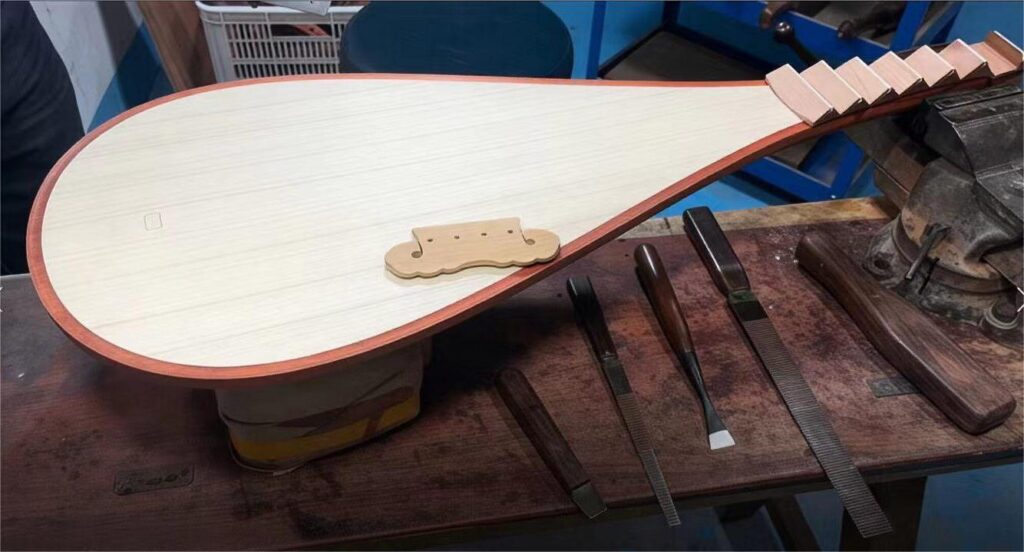
Artisans hand-plane paulownia blanks into flat, precisely calibrated soundboards.
3.1.2 Resonance Chamber Hollowing
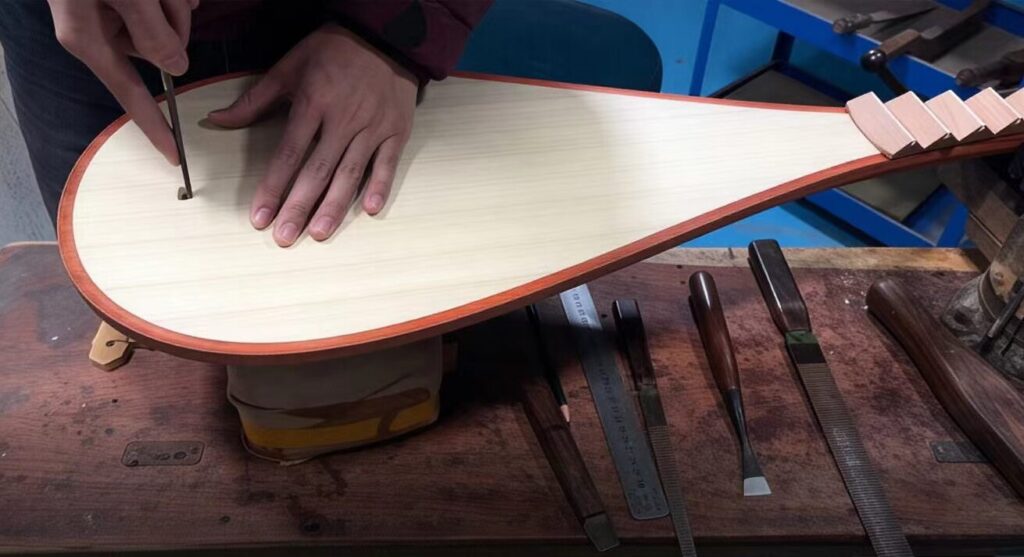
Traditional hand tools shape inner chamber contours, the core procedure determining overall tonal quality.
3.1.3 Headstock Carving
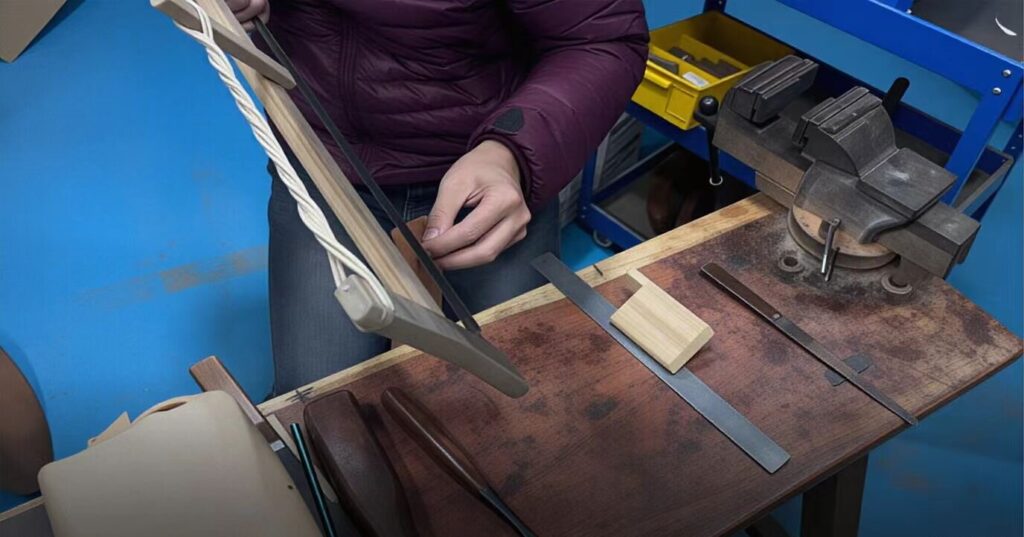
Detailed hand sculpting where every carved line embodies the artisan’s meticulous workmanship.
3.2 Strict Quality Inspection
3.2.1 Acoustic Testing post-completion
- Pitch calibration: Professional tuner verifies accurate fret intonation
- Resonance testing: Measure overall resonance sustain and tonal reverberation
3.2.2 Visual Inspection
- Natural grain coordination and visual harmony
- Precision and fineness of carved ornamentation
- Structural integrity free from defects
Chapter 4 Artistic Characteristics of Bai’s Pipa
4.1 Unique Acoustic Traits
Pure Timbre Crystal-clear sound free of stray noise; bright yet non-harsh treble, mellow full midrange and deep resonant bass with seamless cross-register transition and consistent tonality.
Rich Resonance Prolonged sustain, wide dynamic range and sensitive responsiveness to varied playing intensity for superior musical expressiveness.
Wide Range Nearly four-octave register with penetrating treble and solid bass, adaptable for all musical genres.
4.2 Aesthetic Features
Graceful Contour: Streamlined proportional silhouette based on classic pear-shaped pipa body blended with modern aesthetic design. Elegant Decoration: Harmonious fusion of traditional patterns and contemporary tastes with meaningful refined carving and well-matched natural hues. Exquisite Craftsmanship: Meticulous details showcasing artisan spirit through synergized traditional handcraft and modern technology, every pipa a singular handmade piece.
4.3 Superior Playability
Ergonomic Comfort: Humanized neck design with scientifically calculated fret height and spacing to minimize hand fatigue during extended play. Instant Response: Precise dynamic control and fast string reaction for rapid virtuoso passages. Stable Performance: Minimal susceptibility to ambient temperature and humidity changes; robust build resists long-term deformation for lasting service life.
Conclusion
Bai’s Pipa craftsmanship stands as a precious treasure of China’s intangible heritage, encapsulating ancient Chinese wisdom and creative ingenuity. It is our responsibility to safeguard and advance this ancestral craft to thrive in the modern era.
This compilation aims to popularize Bai’s Pipa and raise public awareness of its cultural value, encouraging collective efforts for folk art preservation. Passing down and developing Bai’s pipa art honors history while fulfilling our commitment to future cultural inheritance.
We strive forward to help this wisdom-rich traditional craft shine brilliantly in contemporary times and contribute to the preservation and promotion of outstanding Chinese traditional culture.
Document Compiled: 2024 Issuing Organization: Bai’s Pipa Craftsmanship Inheritance & Protection Center